Follow our event programme here → endovclinix.com/shipley
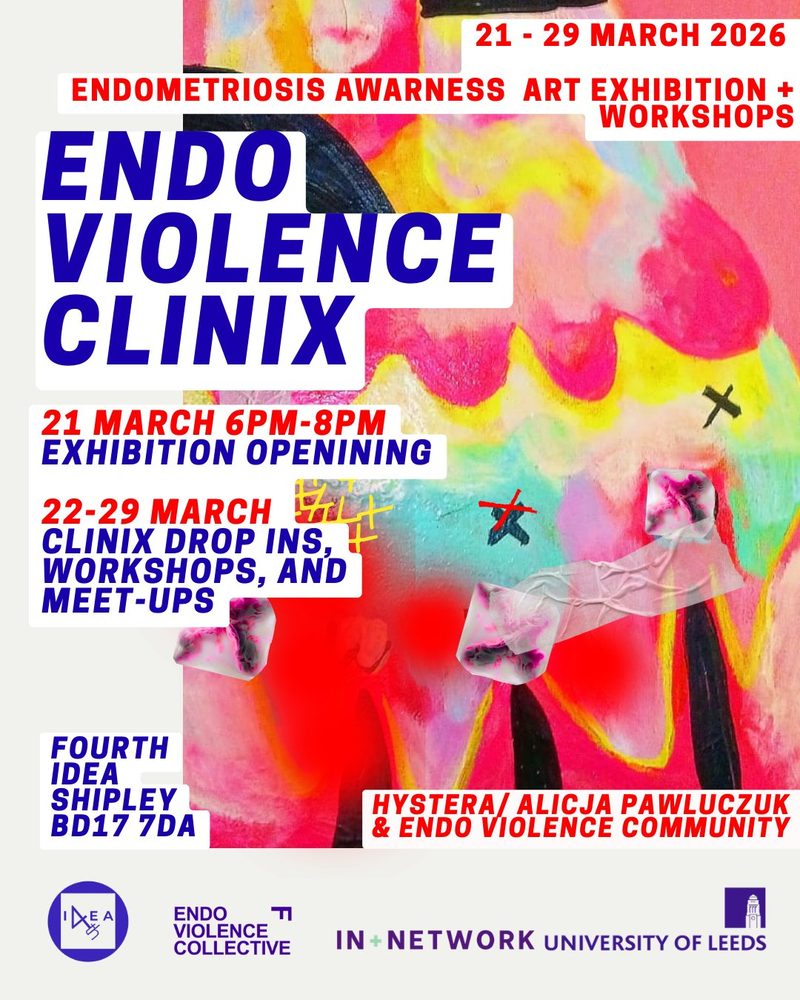
Endo Violence Clinix is an art exhibition, a workshop space, and a community meet-up. We want to share, exchange, and map the local and online resources that might help with the different dimensions of endometriosis and endo violence — practical, emotional, medical, digital, financial, and everything in between. Informed by the history of feminist health activism in the UK, DIY culture, the Well Women Centre movement, and more recent digital activisms, we're trying to create a space to think together about what endo violence free futures might look like. Guided by healing justice principles — not about blaming a specific person or organisation, but about understanding how different systems operate and what becomes possible when communities come together. This space is open to anyone.
We invite all of you to pop in during our opening hours to contribute to our resource mapping. Scroll to the bottom of this page to learn more about what we mean by resource mapping.
Endometriosis affects around 1 in 10 people with a uterus. It takes, on average, nearly nine years to diagnose. 47% of people with the condition visited their GP ten or more times before receiving a diagnosis. This is not bad luck or individual misfortune. It is the result of systemic neglect, underfunding, and gendered dismissal. That’s what we’re here to name.
The endo violence framework was developed collectively — with and by people living with endometriosis — to make visible the multiple forms of harm that surround a diagnosis. Medical, epistemic, relational, digital, environmental, economic, structural. These forms of violence are not separate; they compound each other.
Endo Violence Clinix brings this framework into physical space — as an art exhibition, an artivism space, and a site of collective action. The artists and activists involved use art as method: not decoration, but a way of making visible what institutions refuse to acknowledge. Come to see the work. Come to make something. Come to think together about what resistance looks like.
Endo violence is about healing justice: not pointing fingers at individuals, but looking at how different forms of harm join up — and what we might do together about it.
Dismissal by clinicians, denial of referrals, inadequate pain management, normalisation of symptoms, unnecessary delays in diagnosis. The harm that happens — or doesn’t happen — inside the clinical encounter.
The systematic discrediting of women’s knowledge about their own bodies. Being told it’s “just periods”. Medical education that excludes or minimises endometriosis. Research that doesn’t listen to patients.
Disbelief and minimisation from family, partners, friends, and employers. The exhaustion of having to justify your pain to everyone in your life — repeatedly, often with no result.
Platform algorithms that suppress health content. Social media bans on images related to menstruation. Surveillance of health data. The ways digital systems replicate and amplify offline medical biases.
Endometriosis linked to endocrine-disrupting chemicals in plastics, pesticides, and air pollution. The structural conditions — in housing, work, food systems — that shape who gets sick and who gets care.
The financial cost of endometriosis — in treatments, lost work, private care, products. The ways the condition pushes people out of employment, into poverty, into debt, without adequate support.
NHS underfunding of women’s health. Policy that promises without delivering. Research budgets that don’t reflect prevalence. The systemic inequalities that shape who waits longest and who gets the least.
Endometriosis’s impact on fertility, pregnancy, and bodily autonomy. The ways reproductive choices are constrained, dismissed, or made without adequate information or consent.
Endo violence is a collective issue — or that’s the argument this space is making. It lives in systems, not just in individual bodies. Which means thinking about it, and maybe doing something about it, requires different kinds of people in the same room.
This space is built with you and for you. You don’t need to be diagnosed. You don’t need to have the “right” symptoms. You’re welcome here exactly as you are, in whatever state you’re in.
We know how hard you work. We know the pressures you’re under — understaffing, underfunding, impossible caseloads, a system that fails you as much as it fails patients. This space is not here to blame you. It’s here because we need you in this conversation. The endo violence framework only makes sense if the people with power to change care are part of building what comes next.
Partners, family members, friends who want to understand. Endo violence affects relationships — and understanding the framework can help you show up better for the people you care about.
If you have power to change systems, this space is making the case for why you should. The evidence is here. The framework is here. The community is here. What’s missing is political will.
Make something. Draw, collage, write. Art-making as a way of processing experience that systems refuse to acknowledge. Materials provided.
Adding to a shared map of needs, resources, gaps, and what we wish existed. This is the core activity of the drop-ins — building something together that doesn’t exist yet.
What’s available where you are? What’s missing? Sharing what we know — about services, rights, workarounds, and everything the system doesn’t tell you.
Just being in a room with people who understand. No agenda. Tea, warmth, and the simple relief of not having to explain yourself.
Artwork exploring endo violence, embodied experience, and resistance. Open throughout the clinix — browse at your own pace, stay as long as you need.
Browse the Endo Violence Magazyn at the clinix. A community publication exploring the framework through personal and collective voices.
Endo Violence Clinix doesn’t emerge from nowhere. It sits in a longer tradition of feminist health activism in the UK — one that has repeatedly built spaces of care, watched them get defunded or absorbed, and tried again. Knowing that history feels important.
The Women’s Liberation Movement put women’s health at the centre of feminist politics. Consciousness-raising groups shared testimony about rushed GP appointments, dismissive male doctors, and bodies treated as collections of problems rather than whole lives. Women bought speculums from feminist bookshops and ran self-examination sessions. In 1978, the UK edition of Our Bodies, Ourselves was published — a landmark text that challenged the idea that health knowledge belonged to doctors.
This wasn’t alternative medicine. It was a political argument: that women’s experiential knowledge of their own bodies was valid, and that healthcare systems structured around medical authority were failing them.
Feminist activists shifted strategy. Rather than operating outside the NHS, they pushed to transform it from within. Well Women Clinics emerged across the UK — in Liverpool, Glasgow, Bristol, London, Leeds — offering open-access, women-centred care: longer appointments, female staff, integrated services, and spaces where women could discuss health concerns without judgment.
They demonstrated, powerfully, that there was unmet need everywhere they opened: almost half of women attending Liverpool’s clinics had a vaginal problem or infection; 40% were anxious or depressed.
Most of them closed. Not through a single decision, but through the slow attrition of NHS reorganisation, commissioning fragmentation, and austerity. Services without ring-fenced budgets were absorbed into generic provision or quietly defunded. The feminist philosophy that had animated them was replaced with outcomes-based metrics that couldn’t capture what the clinics were actually doing.
The pattern was consistent across every case: establishment during a window of political sympathy, demonstration of genuine unmet need, institutional resistance to the feminist model, then disappearance — not formally shut down, but allowed to wither.
As Well Women Clinics disappeared, a new form of advocacy emerged — focused, for the first time, on endometriosis specifically. The APPG documented a 7.5-year average diagnostic delay and gathered testimony from women who had visited their GP ten or more times before receiving a diagnosis.
Research confirmed what patients already knew. By 2025, the mean diagnostic delay had risen to nine years — and systemic causes were clear: normalisation of symptoms by clinicians and patients alike, lack of GP training, and fragmented referral pathways.
The 2022 Women’s Health Strategy for England — following a public consultation of over 110,000 responses — promised improved diagnostic pathways, Women’s Health Hubs, and a more serious reckoning with the gender health gap. Early pilot hubs have shown what might be possible: one Oxfordshire hub managed 75% of menopause referrals in-house.
Social media has created 21st-century consciousness-raising spaces. Instagram, TikTok, and community Facebook groups function as spaces where people share diagnosis stories, challenge the normalisation of their pain, and build collective testimony that carries political weight.
The Women’s Health Strategy has no ring-fenced funding. The Women’s Health Hubs are being piloted in some areas and not others, with no guarantee of sustained rollout. A 2024 BMJ editorial called for restructuring endometriosis care and noted the system remains fragmented. The diagnosis delay — now almost 9 years on average — has not improved. It has got worse.
Digital activism can raise awareness, build solidarity, and pressure institutions — but it cannot provide a clinical encounter, a referral, or a diagnosis. Platform algorithms suppress health content. Online harassment targets feminist voices. And the emotional labour of sustained digital advocacy produces burnout in communities already living with chronic illness.
The history of Well Women Clinics is a pointed reminder that good models of women’s health care have existed in the UK for decades. The failure has not been in imagining them — it has been in protecting and scaling them.
Follow the Endo Violence Clinix events programme → endovclinix.com/shipley
This is a community mapping tool — not a definitive directory. Use it to explore the kinds of support that exist (or should exist) across different types of endo violence. Add what you know. Notice what’s missing.
Local and online peer support groups where people with endometriosis share experiences, advice, and solidarity. Often the first place a diagnosis makes sense.
Being told your pain is normal, psychosomatic, or exaggerated is not just frustrating — it’s a recognised pattern with a name. Knowing what gaslighting looks like in a clinical context can help you advocate for yourself.
Relational violence — in families, friendships, workplaces — is one of the least-named forms of endo violence. “But you don’t look ill.” “Everyone gets cramps.” This kind of doubt, even when well-meaning, compounds the harm of being disbelieved in healthcare settings.
Guidance on your rights as a patient — including the right to a second opinion, the right to request medical records, and options if you’ve experienced clinical negligence.
Endometriosis can qualify as a disability under the Equality Act. Benefits including PIP, ESA, and Universal Credit may be available — but the application process is exhausting and often hostile.
You have the right to request reasonable adjustments at work. This includes flexible hours, working from home, rest breaks, or modified duties during flares — without having to justify your pain repeatedly.
A government grant scheme that funds support in the workplace for people with health conditions or disabilities — significantly under-used by people with chronic conditions.
Pelvic floor physiotherapy, pain management clinics, and chronic pain psychology are all relevant to endometriosis — but often hard to access, long waits, or not offered at all.
Period poverty is a real dimension of endo violence — especially when managing a condition that requires higher-absorbency or more frequent product changes.
Public libraries as access points — for printing forms, using computers to navigate benefit applications, accessing health information, and community meeting space.
In the UK, complex or severe endometriosis should be treated at a BSGE-accredited centre. You have the right to request referral — but many GPs don’t offer it. Knowing it exists is the first step.
Endometriosis may qualify as a disability under the Equality Act 2010 if it has a substantial and long-term effect on daily life. This creates legal obligations for employers.
Medical trauma, chronic pain, and years of being disbelieved take a real psychological toll. Therapy and peer support specifically for people with chronic illness exists — though it takes work to find.
Hardship funds, charitable grants, and mutual aid within endo communities. Also crowdfunding for surgeries or treatments not available on the NHS.
This is a starting point — an example of how we might map needs and support together. In the clinix, we want to build this with you, not show you a finished version. Click any card to explore.
This is an example only. What’s missing? What would you add?
At the centre is you — navigating a condition that most systems weren’t built to support. Everything in this web is about what you might need, and what we might offer each other.
Specialist referrals, pain management, getting a diagnosis, navigating the NHS.
By family, friends, partners, employers, doctors. The need to have your pain taken seriously — not explained away, minimised, or made your fault.
Endo costs money — in treatments, time off work, travel, products. Support exists but is hard to find and often exhausting to access.
Your workplace has legal obligations. You have rights — to adjustments, to flexibility, to not having to explain your pain every week.
The everyday things that make managing endo harder or easier — products, information, space to rest, somewhere safe to go.
Years of being dismissed take a toll. Medical trauma, grief about diagnosis, exhaustion from advocating — these are real and they deserve real support.
Sharing what we know. Naming what’s missing. Showing up for each other. This is what the clinix is trying to be a space for.
Knowing what you’re entitled to. Understanding the framework. Finding the right words.
This map is incomplete by design — it reflects the gaps in provision as much as what exists. During the drop-in, you’re invited to add to it: post-it notes, conversations, resource sheets. What do you know that others don’t? What have you needed that wasn’t there?
You don’t need a diagnosis to be here. You don’t need to know the framework. You just need to care — about bodies, about systems, about justice.